Quick answer
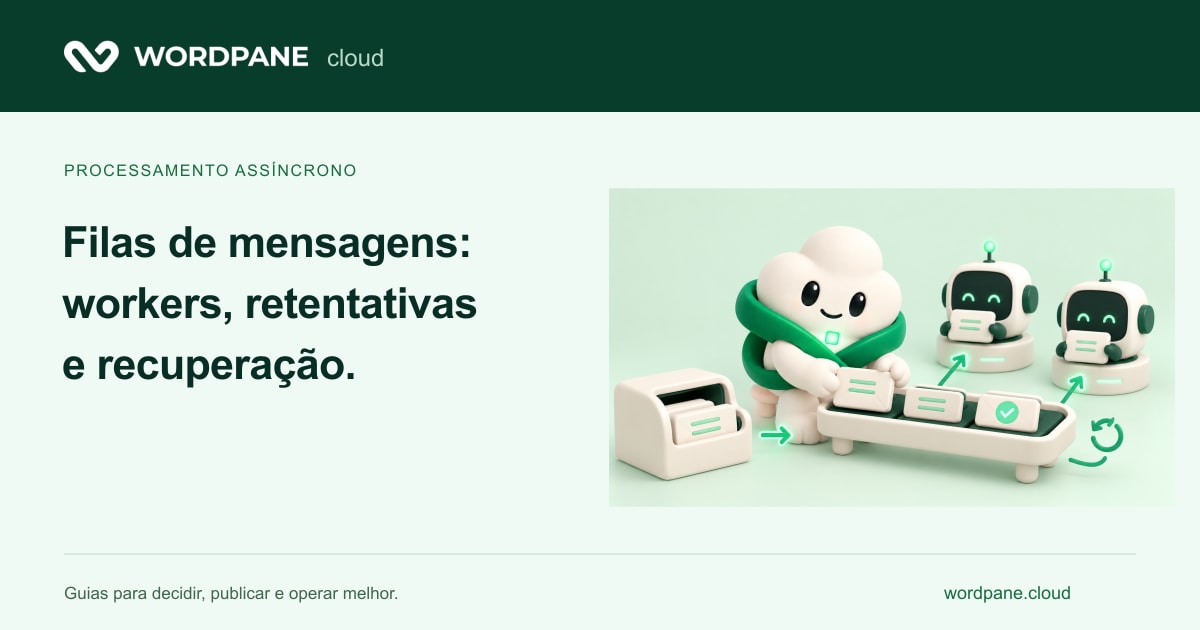
A queue records work for workers to execute, reducing the need to finish slow tasks within the user’s request. It does not guarantee that each action happens exactly once. The architecture must define acknowledgements, persistence, idempotency, retries and failure recovery.
Generating a report, converting a file or calling an external API can take longer than an interaction should wait. Putting the task on a queue is not the end: users need status updates, the team must recognize failures, and retries must not repeat consequential actions without control. This guide separates those decisions into a verifiable flow.
- Register request
- Publish identifiable work
- Process and confirm
- Recover faults with control
Decoupling changes the contract with the user
In synchronous execution, the response aims to represent completed work. In an asynchronous flow, the initial response may only confirm that a request was accepted and recorded. The interface must distinguish pending, running, completed and failed states. A success indicator must not announce completion before it happens.
Choose tasks whose results can be tracked and recovered. A queue may fit file processing or report generation, but it is not an automatic answer to every latency problem. Work that must answer the business immediately still needs its own design.
Publication and processing are different confirmations
In RabbitMQ, publisher confirms and consumer acknowledgements cover different boundaries. Publisher confirms track the broker’s acceptance of a publication according to its configuration; consumer acknowledgements report handling of a delivery by a consumer. A broker confirmation does not prove that the application completed its work.
The design also depends on persistence, durability and queue type employed. Do not treat a resource name as absolute warranty against any failure. Document at which point the application considers the task accepted and at which point considers its result completed and persisted.
Plan the gap between recording data and publishing a message
If an API saves the request and fails before publishing, the database can show work that no worker has received. If it publishes before completing the registration, the worker may find a yet unavailable identifier. They are coordination failures between components, not just syntax errors.
One strategy to evaluate is persisting pending work alongside the application operation and using another process to publish and track that record. The design must handle concurrency and recovery. Do not claim that two operations in different systems are atomic without a mechanism that supports that property.

Idempotency is a property of the action, not just the message
Use a stable operation key and persistent state to recognize that an effect already happened. Assigning a new identifier to every retry can prevent duplicate detection. A temporary check that disappears on restart may also be insufficient.
As a hypothetical example, a worker creates a report’s final file and fails before acknowledging delivery. The message returns. Processing must recognize the valid result or resume safely. For sending, charging or another external effect, protection also depends on that service’s contract; marking a row before a call and ignoring what happened afterward is not enough.
Acknowledge after a recoverable success point
Acknowledging a delivery before persisting its result can remove the opportunity to recover through redelivery. Never acknowledging messages is not a strategy either: work may be repeated or unfinished deliveries may accumulate. Define the boundary precisely and test interruptions on both sides.
The worker needs to deal with closure and connection failure. The team should know if an ongoing message will be delivered again and how to recognize the effect already produced. The actual behavior depends on the libraries and settings used, so the failure test is part of the delivery.
Retries need limits and error classification
Temporary unavailability may justify another attempt after a delay. Invalid input probably requires correction or rejection. Immediately and endlessly repeating a task that always fails consumes capacity and can worsen an external service’s problem.
Define retry counts, delays and a destination for review. An error queue or dead-letter mechanism needs configuration and monitoring. RabbitMQ documentation describes forwarding conditions and risks; do not treat that destination as an infallible archive that preserves every message forever.
Monitor age and result, not just quantity
A short queue containing a very old job may indicate a blockage. A large queue may be expected during a planned batch. Observe arrival and completion rates, the oldest job’s age, errors and time until a result becomes available to the user. Interpret those measurements in context rather than merely displaying a count.
Avoid storing personal content or credentials in messages when an authorized identifier allows you to search for the necessary data. Review retention, permissions, and those who can query errors. Logs should help correlate an operation without turning diagnosis into an uncontrolled copy of customer data.
More workers can increase contention
Increasing concurrency helps when spare capacity exists and the task can run in parallel. It can also create competition for CPU, memory, database connections and API limits. If an external service accepts few operations at once, adding workers can increase failures and retries rather than reduce delay.
Measure task duration and completion capacity under the expected load. Separate very heavy tasks from short ones when the design allows it. Define limits by operation type and assess the effect on the public application when components share a server.
Test flaws in points that reveal the contract
Perform the test with data and test destinations without triggering undue real actions. Document the expected state after each interruption. The goal is not to prove absence of any failure, but to demonstrate that the team can recognize and recover the relevant situations.
An implementation is only operationally ready when the review procedure exists and someone manages to execute it. A task marked as failure needs to lead to a known decision instead of getting lost in a panel.
- Resend the same operation and verify that the effect is not duplicated.
- Interrupt the worker before saving the result and verify recovery.
- Interrupt after effect and before confirmation and test idempotency.
- Simulate a permanent error and verify retry limits and failure routing.
- Simulate dependency unavailability and observe the backlog.
- Resume an authorized task and record its final result.
How WordPane supports worker planning
The WordPane documentation features scheduled tasks, Supervisor and log and metric features that help organize compatible processes and track the environment. The backup strategy with external destination also needs to consider the persistent state of the application, settings, and data required for recovery.
These tools do not mean that RabbitMQ or every other broker is installed and natively managed in every stack. Confirm runtime, commands, persistence and additional services in the project scope. Bring task volume, peak load, duration and recovery rules to the briefing to assess infrastructure and responsibility for each component.
Plan the capacity of your processes in the background
Describe volume, duration, dependencies and recovery to evaluate the appropriate environment for workers.
Size my workers with WordPaneConsult panel documentation